An apartment sauna is entirely possible in an ordinary room — it’s built from scratch to fit the space exactly. The three things to get right are ventilation, electrical supply and protecting the walls from steam. The price of an indoor sauna is calculated individually: it depends on the room’s size and height, the wood, the heater, how much preparation the room needs, and the decor. Here’s what you need to know.
What is an indoor sauna?
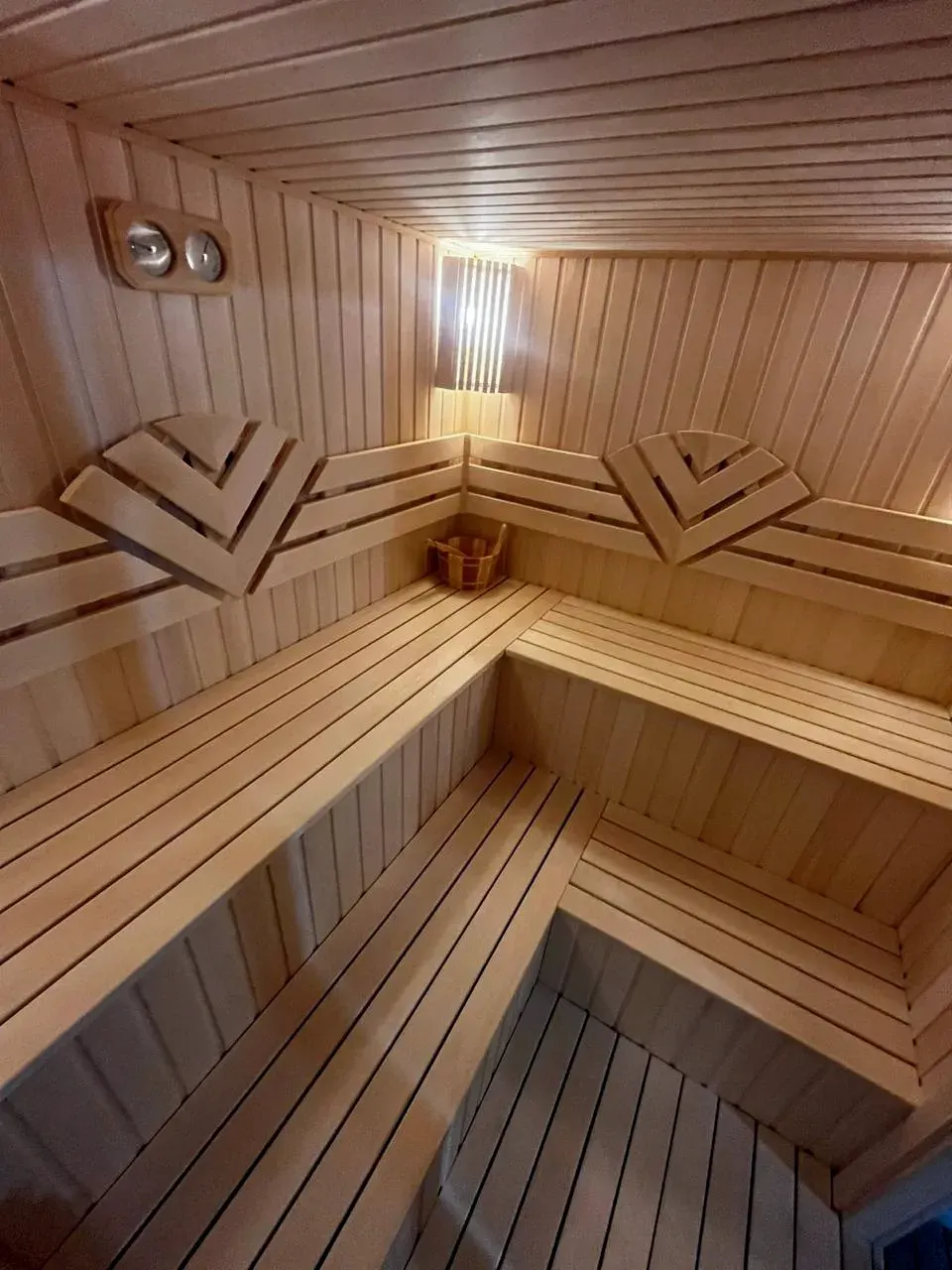
An indoor sauna is built inside an existing room — in an apartment, house, villa, hotel or spa. It isn’t a prefabricated box: the frame, insulation, lining, benches and lighting are all tailored to the specific room. That’s why a sauna can fit into a corner of a bathroom just as well as a spacious basement room. See examples on our indoor saunas page.
Room requirements
Size and height
- Floor area. A 1–2 person sauna can fit in a small room or even part of a bathroom. For 4–6 people you’ll want more space, with two-tier benches.
- Height. There’s no need for a tall sauna ceiling: hot air rises, and extra volume just takes longer to heat. The sauna ceiling is usually set a little lower than the room’s own ceiling.
- Location. It’s convenient to have a shower or bathroom nearby for cooling off between rounds.
Floor
The floor must be moisture-proof — tiles are ideal. A floor drain near the shower is a bonus. A removable wooden duckboard goes on top so it feels warm and soft underfoot.
Ventilation
Good airflow matters for both comfort and safety:
- Fresh-air inlet — usually low down, near the heater.
- Exhaust — high up or on the opposite side, connected to the building’s ventilation.
- Drying out — after each session, leave the door open to air the sauna so no moisture stays in the wood.
In an apartment, plan the exhaust route early — it directly affects where the sauna can go.
Electrical supply
In apartments and inside most houses, saunas run on an electric heater. Keep in mind:
- The heater needs a dedicated circuit with its own breaker.
- Heater output is matched to the room volume; for more powerful models, an electrician should confirm your supply can handle it.
- The control panel can be mounted outside the sauna in a convenient spot.
Barrel Sauna supplies and installs Harvia, SAWO, Teplodar, TMF and Fanlan heaters — browse them on the sauna heaters page.
Protecting the walls: insulation and membrane
The most common question: “Won’t a sauna damage my walls?” Built properly — no. A multilayer insulation system sits between the existing walls and the sauna frame:
- Mineral stone wool — keeps heat inside the sauna and speeds up heating.
- Moisture-resistant membrane — stops steam and humidity from reaching the walls of your home.
- Timber lining — in the wood of your choice.
This build-up protects your walls from steam and damp, while the sauna heats faster and uses less energy. Learn more about the build stages on our sauna construction page.
Choosing the wood
| Wood | Properties | Best for |
|---|---|---|
| Linden (lipa) | Resin-free, smooth, light-coloured, never burns your skin | A classic, bright interior |
| Thermo linden | Heat-treated; resists moisture, rot and warping; dark caramel colour, light pleasant scent | Modern design in warm tones |
| Abachi (ayous) | Very low heat conductivity, knot-free, no splinters — the world’s #1 bench material | Those who put comfort first |
| Cedar | Natural essential oils, antibacterial, aromatherapy, resists moisture and mould | Lovers of scent and natural benefits |
| “Wild sauna” | Built from whole linden logs and stumps; raw natural texture, a forest feel | Anyone after something truly different |
Woods can be combined — for example, thermo-linden walls with abachi benches.
What determines the price
Indoor saunas don’t have a fixed price — each project is calculated for its room. The main factors are:
- Room size and height — more timber, more insulation, a stronger heater.
- Wood species — from linden to premium woods.
- Heater — output, brand and control panel.
- Room condition — how ready the walls, floor and ventilation are.
- Bench layout — one or two tiers, L-shaped, room to lie down.
- Decor and lighting — decorative stones, Himalayan salt panels, log-cut decor, LED lighting.
- Glass door or glass wall — a visual link between the sauna and the room.
To get an exact price, the room’s dimensions and a few photos are all we need.
How an indoor sauna is built: the stages
- Survey and consultation. We take the room’s measurements, photos and your wishes, and check ventilation and power options.
- Design. We plan the benches, heater, door and lighting; a design visualisation can be prepared.
- Preparation. Where needed — a power circuit, a ventilation outlet and a moisture-proof floor.
- Frame and insulation. The timber frame goes up, followed by mineral wool and the membrane.
- Lining and benches. Walls and ceiling are clad in your chosen wood and the benches are assembled.
- Heater, lighting and decor. The heater is connected, LED lighting and decor are installed, and the sauna gets its first heat-up.
Planning every stage in advance means nothing has to be redone later.
Apartment sauna: what to check in advance
Before building a sauna in an apartment block, sort out a few practical points:
- Power capacity. Check with an electrician that your apartment’s allocated supply can handle the heater.
- Ventilation outlet. Work out how exhaust air will be routed into the building’s ventilation duct.
- Building rules. Where required, agree the work with building management — especially electrical and ventilation work.
- Water and floor. Placing the sauna near a shower with a moisture-proof floor is both convenient and safe.
FAQ
How much does an apartment sauna cost?
It’s priced individually — room size, wood, heater and decor are the main factors. Send us photos and measurements of the room and we’ll prepare an exact quote.
Can I use a wood-burning stove in an apartment?
Apartment saunas are typically built with an electric heater, which is both safe and convenient. Wood stoves are mainly for outdoor saunas.
Will the walls get damp?
No. Multilayer insulation of mineral wool and a moisture-resistant membrane keeps steam out of the walls.
What’s the minimum space needed?
A 1–2 person sauna can fit in a small room or a corner of a bathroom. We’ll confirm what’s possible once we see the floor plan.
Which wood is best for an apartment sauna?
Linden is the classic; thermo linden adds moisture resistance and a darker tone, abachi is best for benches, and cedar brings aroma. Woods are often combined.
Plan an indoor sauna for your home
Send us the room’s measurements and a few photos, and we’ll work out together how to fit the sauna and which wood and heater to choose. Message us on WhatsApp for a free consultation, a design and an individual price.